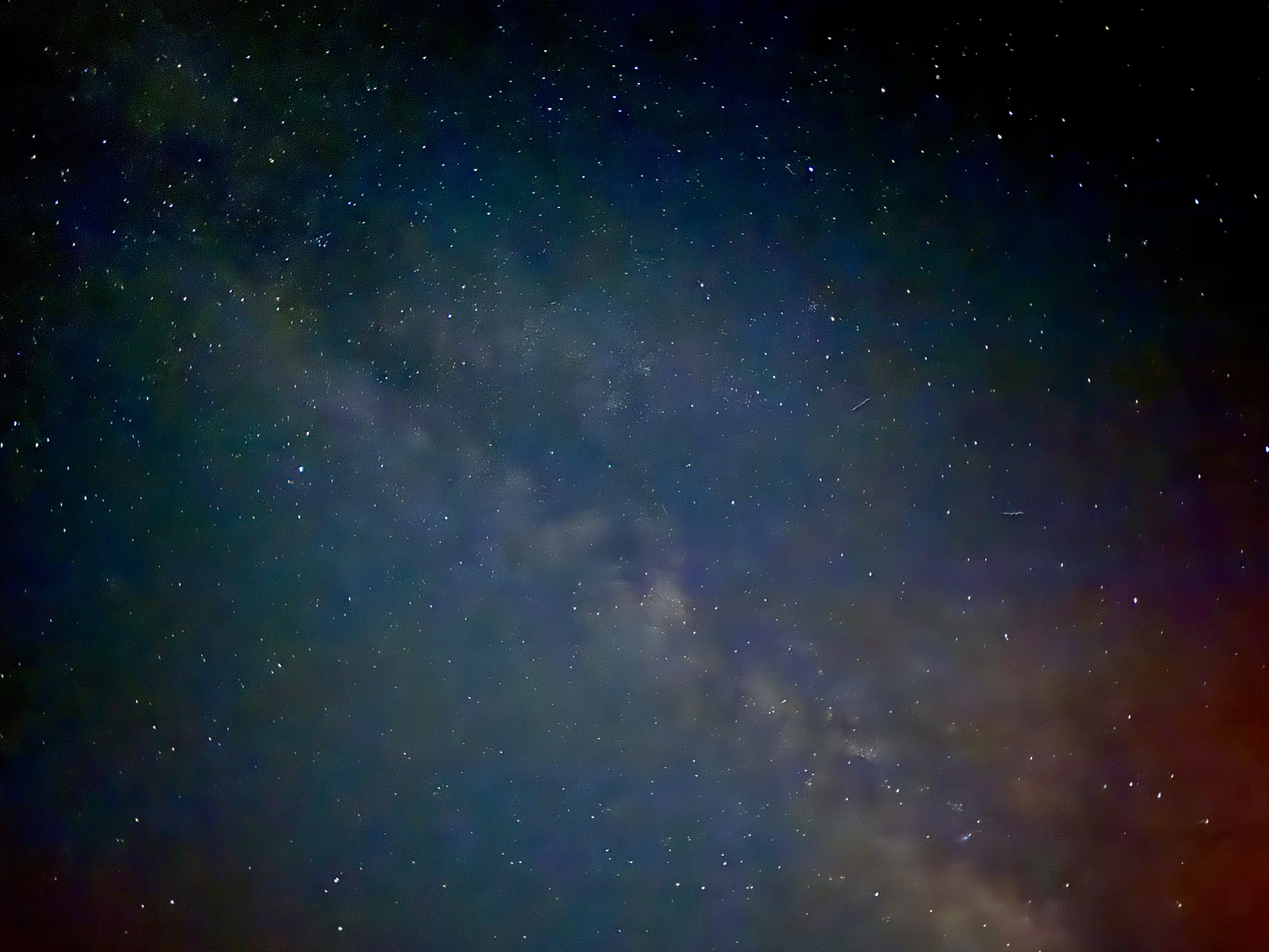
On July 18, I drove out to Astrofest at Badlands National Park for an evening of stargazing under one of the darkest skies in South Dakota. Astronomer Dean Regas kicked things off with a constellation talk before dark, walking through the sky most of us casually look at without appreciating the complexity. I have known the Big Dipper since childhood. By the end of the evening, I could confidently pick out Corona Borealis, the near-perfect little semicircle rising overhead, and Arcturus, the orange-red giant that anchors the constellation Boötes and turns out to be one of the brightest stars in the northern sky.
At the Scope (telescope, not my usual Mohs microscope)
The University of Utah astronomy team and a smattering of amateur astronomers had set up ten or fifteen telescopes on the flats, each trained on a different piece of the night. We wandered from scope to scope in a loose queue, chatting briefly with the astronomers as they made micro-adjustments to bring a celestial body into focus. Three of the views stuck with me.
The first was Messier 13, the great globular cluster in Hercules. To the naked eye it looks like a single faint star. Through a telescope it resolves into a dense spherical swarm of somewhere between 300,000 and 500,000 stars, packed into a region roughly 150 light-years across. Standing there trying to make my eye accept that one point of light in the sky is actually half a million suns reordered my sense of scale. We live in an unfathomably enormous galaxy, yet occupy a miniscule slice of it.
The second was Albireo, the star at the head of the Swan (Cygnus). Through the eyepiece it splits into a matched pair — one warm yellow-orange and the other a cool sapphire blue, sitting close together against the black. It is a cinematic double star in the northern sky and looks almost artificial, like someone deliberately posed them for the shot.
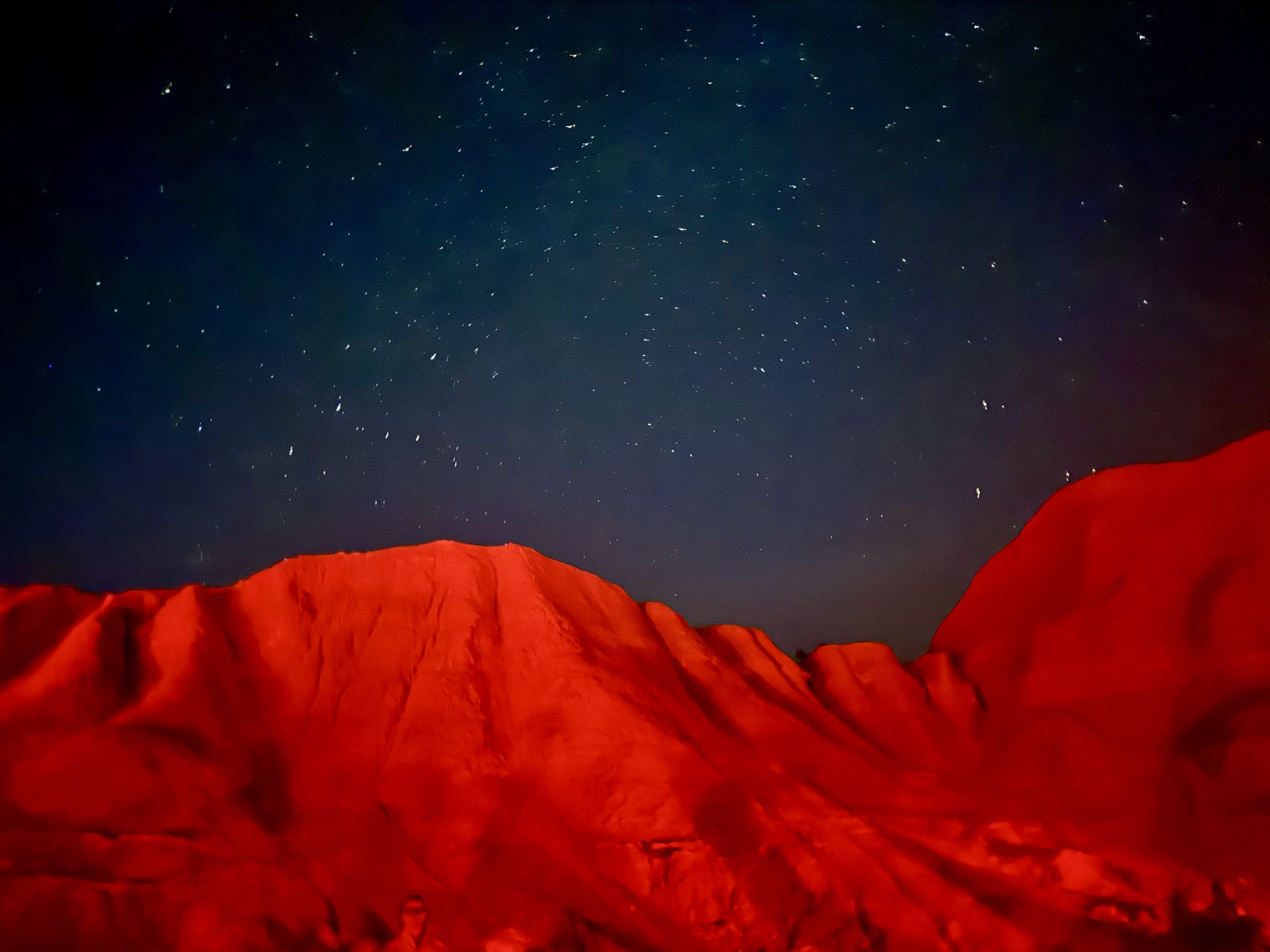
And the third, of course, was the moon. Through a telescope the moon is startling: I couldn't help but appreciate the similarity between the harsh topography of the badlands and the moon's pearly surface. The terminator — the line between lit and shadowed lunar surface — throws every crater into sharp, three-dimensional relief. The pockmarks are enormous. (An aside for the dermatology-inclined: the word "pockmark" describes the atrophic, depressed scars left by smallpox — more commonly from acne or chickenpox these days.)
An International Dark Sky Park
This year's Astrofest happened to coincide with a milestone: on July 17, Badlands National Park was officially designated an International Dark Sky Park by DarkSky International. It is the first Dark Sky Park in South Dakota and one of only a small handful in the National Park Service's Midwest Region.
The designation is not just an honorific. It requires demonstrated commitment to protecting the night sky — replacing outdoor lighting with fully shielded, warm-color fixtures, monitoring sky brightness over years, and educating visitors about how much artificial light we now spill upward without noticing. Roughly 80% of Americans live under skies too light-polluted to see the Milky Way from home. The point of a Dark Sky Park is that a genuinely dark sky is a resource, and it takes deliberate work to keep one intact. Standing on the badlands floor after full dark, with the Milky Way arcing overhead, it's easy to see the value in preserving this resource.
Moonbathing
Moonlight is, of course, just reflected sunlight — and the moon's surface reflects only around 12% of the light that hits it, which is why full moonlight is roughly 400,000 times fainter than direct sunlight at midday. The UV component of moonlight is attenuated, then further reduced by atmospheric scattering by the time it reaches your skin. The practical dermatologic amount is zero. Moonbathing, in other words, is entirely dermatologist-approved. No sunscreen required.
Disclaimer: This article is general educational content, not medical advice.
References
National Park Service. Astronomy Festival — Badlands National Park. Accessed July 2026.
DarkSky International. Badlands National Park Earns International Dark Sky Park Designation. July 2026.
Karpova NN. Spectral Reflectivity of the Moon. J Res Natl Bur Stand. 1953;51(2):81.